
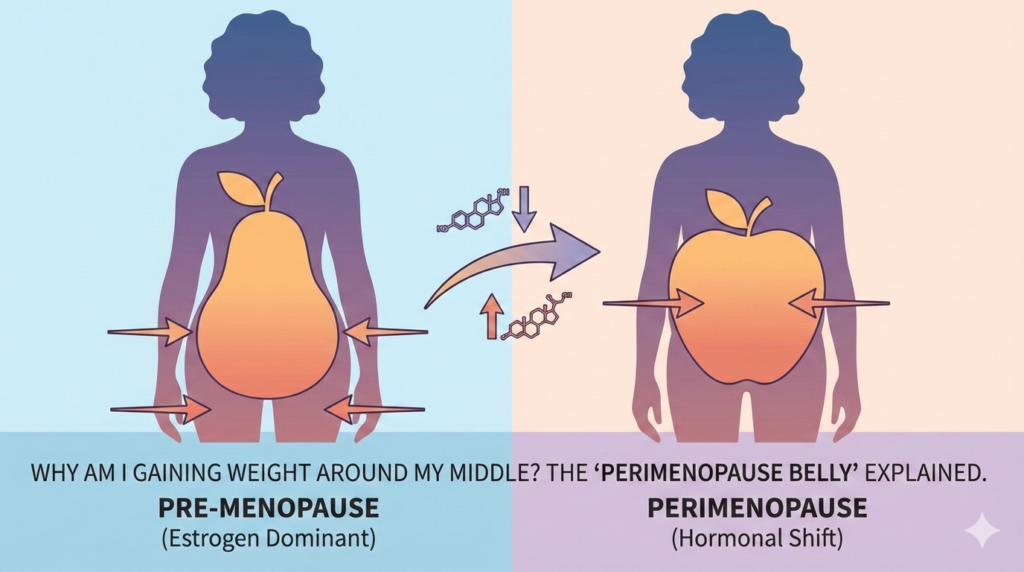
You’ve been eating the same way for years. You still go for your morning walks. Yet, seemingly overnight, your favorite pair of jeans won’t zip, and you’re noticing a “thickening” around your waistline that wasn’t there before.
If this sounds familiar, you aren’t “losing your discipline.” You are likely experiencing one of the most frustrating milestones of the menopausal transition: the shift in body composition often called “perimenopause belly.”
While it feels like a personal betrayal, there is a very real biological blueprint behind why this happens. Let’s break down the science of why your weight is shifting and, more importantly, how to tell if your hormones are the primary culprit.
The Biological Shift: Why the Belly?
During your 30s and early 40s, your body typically stores fat in a “pear” shape—around the hips and thighs. This is largely driven by active estrogen levels. However, as you enter perimenopause, estrogen levels begin to fluctuate wildly before eventually dropping.
1. The Estrogen Drop & Fat Storage
When estrogen declines, the body’s “fat storage map” changes. Instead of the hips, the body begins prioritizing the abdomen. This isn’t just “under the skin” fat (subcutaneous); it is often visceral fat, which sits deeper around your organs.
2. Muscle Mass vs. Metabolism
As we age, we naturally begin to lose lean muscle mass (a process called sarcopenia). Because muscle is metabolically active—meaning it burns calories even while you sleep—losing it causes your basal metabolic rate to slow down. If you don’t adjust your protein intake or resistance training, the scale starts to creep up.
3. The Cortisol Connection
Perimenopause is often a high-stress season of life (the “sandwich generation” years). High stress leads to elevated cortisol. Cortisol is a “belly-fat hormone”; it specifically tells your body to protect your midsection by storing energy there.
Stop Guessing. Is it your lifestyle or your hormones?
Before you try another restrictive “crash diet,” find out where you actually are in your hormonal journey. Our [Perimenopause Analyzer Tool] looks at your cycle patterns, age, and specific symptoms like sleep loss and brain fog to give you a clearer picture.
Beyond the Scale: Supporting Symptoms
Weight gain rarely travels alone. If you are noticing a “thickening” middle along with any of the following, you are likely in the early or late transition phase:
- Insomnia: Sleep deprivation spikes hunger hormones (ghrelin).
- Irregular Periods: Shifts in cycle length are the #1 sign of perimenopause.
- Night Sweats: Making you too exhausted to stay active during the day.
How to Manage the Transition
You cannot “starve” your way out of a hormonal shift. Instead, focus on these three research-backed pivots:
- Prioritize Protein: It protects the muscle mass you have and keeps you full.
- Lift Heavy Things: Strength training is the “antidote” to a slowing metabolism.
- Manage the “Internal Heat”: Reducing alcohol and caffeine can lower cortisol and improve the sleep quality needed for weight maintenance.
The Bottom Line
The “perimenopause belly” is a signal, not a life sentence. It’s your body’s way of asking for a different kind of care than you provided in your 20s. The first step to feeling like yourself again is gaining clarity on what is happening inside.
Is it perimenopause? Don’t wait for your doctor’s appointment to start gathering data. Use our interactive Perimenopause Analyzer to track your symptoms, visualize your patterns, and download a report you can take to your next consultation.
[Start the Perimenopause Assessment Today]
Medical Disclaimer
This content is for educational and informational purposes only and does not constitute medical advice. Always consult with a qualified healthcare professional regarding any changes to your health, weight, or hormonal symptoms.